

The Best Educational Resources for Children are not necessarily the most expensive apps, newest devices or biggest subscription bundles. Good resources help a child do something valuable: read, reason, practise, create, investigate, communicate or solve a problem. For African families, the best choices also need to work with real constraints such as data cost, device access, curriculum differences and local language.
This guide presents ten resource types rather than a paid “top products” ranking. That makes it useful whether your child learns in Lagos, Nairobi, Accra, Johannesburg, Kigali, Cairo or elsewhere on the continent.
How to choose the best educational resources for children
Start with the learning goal. Ask: What skill does my child need to develop? How will this resource make the child practise that skill? Can I tell whether learning is improving? Technology can help, but UNESCO emphasizes human agency, critical thinking and responsible use in digital learning. A shiny interface is not evidence of educational value.
1. Age-appropriate storybooks
Books remain one of the highest-leverage learning resources. For emerging readers, choose clear print, engaging pictures and language the child can understand. For stronger readers, widen genres: stories, biographies, science, history, poetry and informational texts.
Include African authors, settings and experiences alongside global literature. Representation can strengthen relevance, while diverse reading expands a child’s view of the world.
2. A home or community library routine
Access matters as much as ownership. Use school libraries, public libraries, community book programmes or book swaps where available. A simple borrowing routine can expose children to more material without requiring a large household book budget.
Create a regular reading time and talk about what was read. Ask questions such as “What surprised you?” or “What would you do differently?” rather than turning every story into a test.
3. Printables and practice sheets used selectively
Worksheets can help with handwriting, arithmetic fluency, spelling or revision when used for a clear purpose. They are less useful when they become hours of repetitive busywork.
Choose short practice that reveals what a child understands. Then move to conversation, reading, play or a real-world task that applies the skill.
4. Hands-on STEM materials
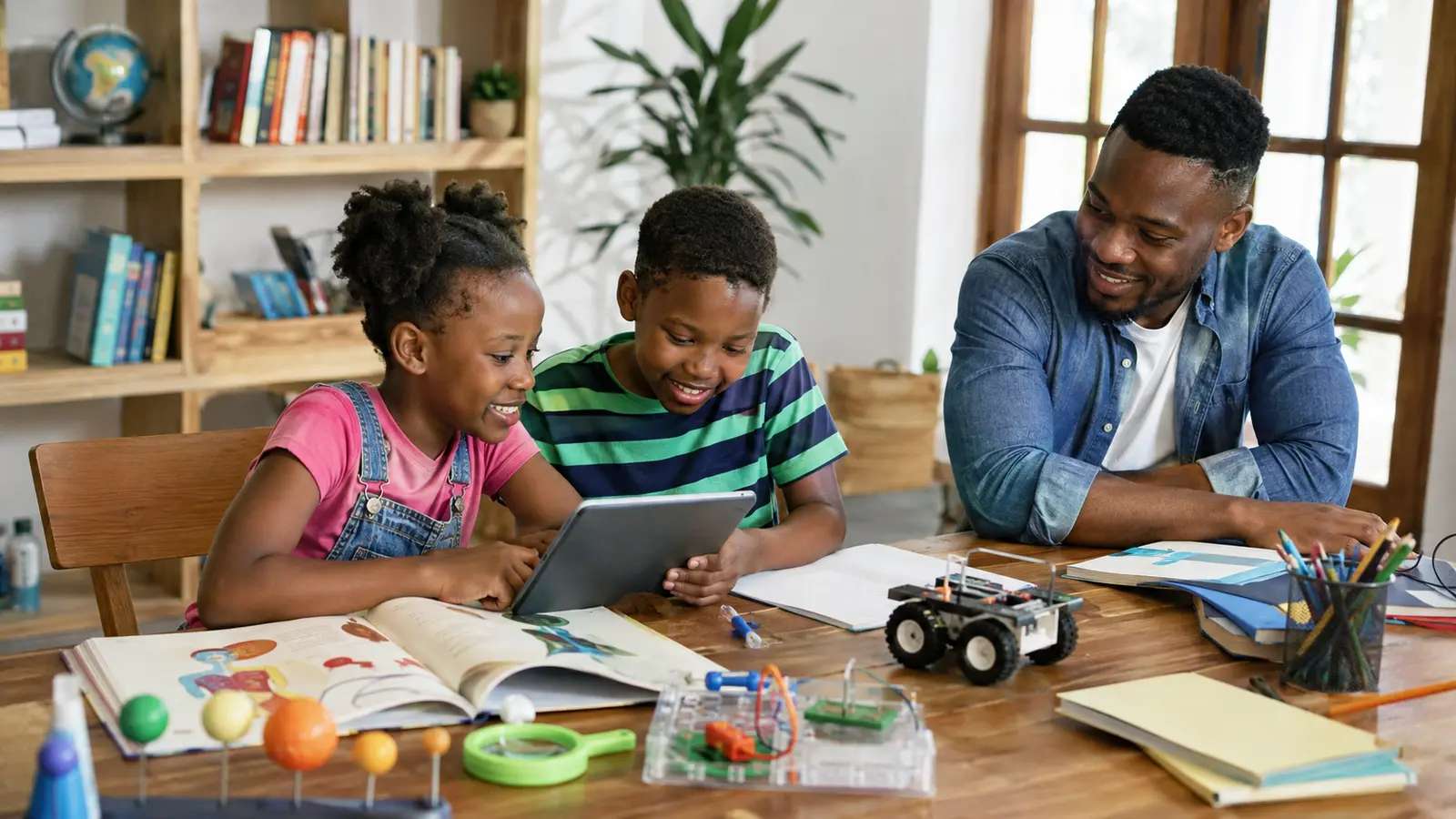
You do not need an expensive robotics kit to begin STEM learning. Measuring cups, paper, cardboard, rubber bands, magnets, recycled containers and simple electronics can support experiments and design challenges.
Ask children to predict, build, test and improve. That cycle develops problem-solving more effectively than simply watching a science video. See our STEM Education Africa guide for practical ways to make STEM active.
5. Carefully selected learning apps
An app should make the child think, practise or create. Check the age range, privacy practices, advertising, offline options, feedback quality and whether the child is actively responding rather than passively tapping.
Try the app yourself before handing it over. For younger children especially, learning improves when adults sometimes participate and connect screen content to real life.
6. Offline digital resources
Where connectivity is expensive or unreliable, downloadable lessons, offline reference materials and preloaded educational content can be more practical than always-online platforms. Download over affordable or trusted connections when possible and organize files so children can find them again.
Offline-first choices can also reduce distractions from social feeds and notifications.
7. Educational video with active follow-up
A good video can demonstrate a process that is hard to explain in words, but watching alone can feel like learning without producing much practice. Pause to predict what happens next, ask the child to explain the idea, then try a related problem or experiment.
For device boundaries and online safety, use the principles in our Digital Parenting Africa guide.
8. Games that build thinking
Board games, card games, puzzles, word games and strategy games can strengthen counting, planning, vocabulary, memory and social skills. Traditional games can also carry cultural knowledge and encourage intergenerational play.
The learning value often comes from explaining choices, taking turns, adjusting strategies and coping with losing, not from an “educational” label on the box.
9. Real-world learning tools
A kitchen, shop, garden, transport map or family budget can become a learning environment. Children can measure ingredients, estimate costs, compare prices, read signs, track plant growth or plan a route.
These activities connect school knowledge to everyday competence and often cost little.
10. A knowledgeable adult
The most powerful resource may be a parent, teacher, older sibling, librarian, coach or mentor who asks good questions and gives useful feedback. The World Bank’s work on education in Africa repeatedly highlights the importance of teachers, learning materials and supportive conditions together rather than resources in isolation.
Quick resource checklist
| Question | Good sign |
|---|---|
| What skill does it build? | The learning goal is clear |
| Is the child active? | Reading, solving, building, explaining or creating |
| Is it accessible? | Works with your device, data, language and budget |
| Is it safe? | Age-appropriate content and sensible privacy |
| Can learning transfer? | The child can use the skill away from the resource |
For a broader learning plan, pair resources with realistic expectations from our Child Development Milestones guide and the family foundations in our African Parenting Guide.
Frequently asked questions
Do children need tablets to learn well?
No. Devices can expand access, but books, conversation, play, writing, hands-on projects and skilled teaching remain powerful learning tools.
How can parents tell whether an educational app is useful?
Look for active practice, meaningful feedback, age appropriateness, privacy protections and a clear connection to a learning goal. Watch how your child actually uses it.
What if we cannot afford many learning resources?
Prioritize access and routines over quantity. Libraries, book swaps, reused materials, household maths, storytelling and carefully selected free resources can support meaningful learning.
Final thought
Build a small learning ecosystem instead of collecting products. Combine reading, conversation, hands-on exploration, selective digital tools and supportive adults. The best resource is the one your child can access consistently and use to think more deeply.