


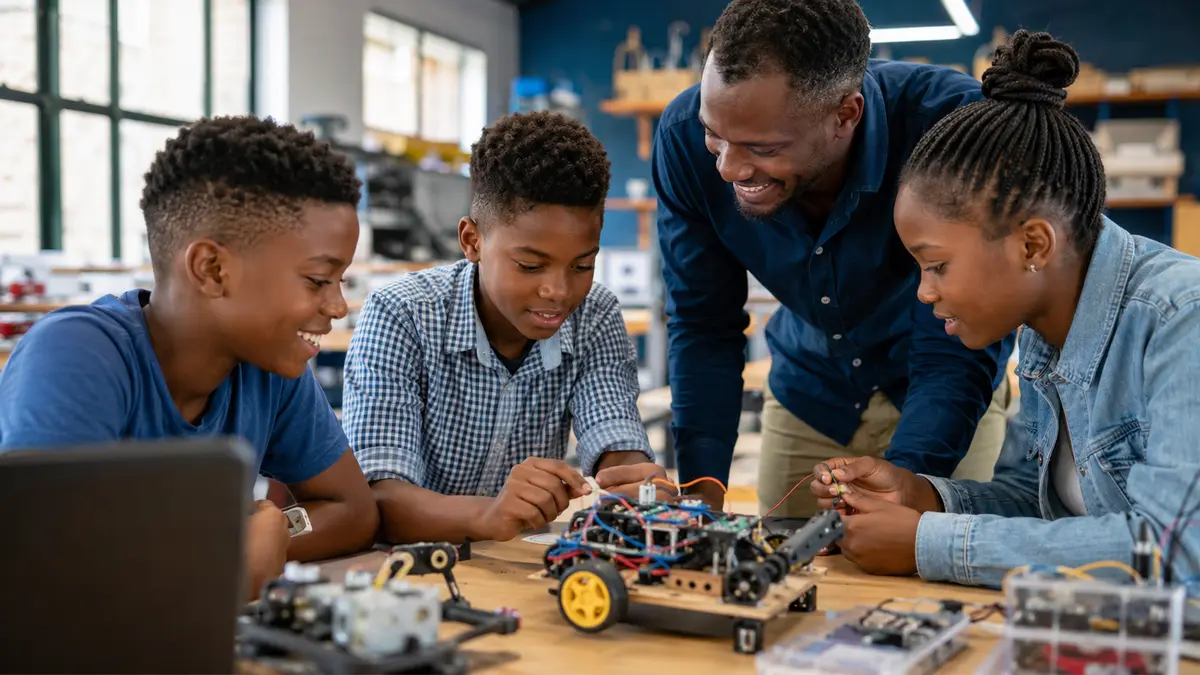
STEM Education Africa should not mean buying the most expensive robot kit or pushing every child toward engineering. At its best, STEM helps children learn how to ask useful questions, test ideas, solve problems, work with others and understand the technologies shaping their future.
For African parents, the opportunity is especially important because access to laboratories, connectivity, trained teachers and devices remains uneven. The smartest strategy is to build durable thinking skills first, then add tools as access allows.
STEM Education Africa: why it matters now
UNESCO argues that strengthening contextually relevant STEM education in Africa requires teacher development, classroom resources and progress on the digital divide. Its recent work also highlights coding, digital skills and practical technologies as part of future learning. That makes home support valuable, but parents should complement schools rather than try to recreate a laboratory at home.
1. Start with curiosity, not coding
When a child asks why a shadow changes, how a bridge stays up or why a phone responds to touch, resist the urge to provide the answer immediately. Ask, “What do you think?” Then test a small idea together. Scientific thinking begins with observation and evidence long before a programming language.
2. Turn everyday African life into a STEM laboratory
Measure ingredients while cooking. Compare how quickly wet clothes dry in different locations. Estimate the water a household uses. Examine why certain building materials handle heat differently. Track rainfall. Design a way to keep a fragile object safe during a drop. Local problems make STEM meaningful and demonstrate that innovation is not something that happens only abroad.
3. Teach computational thinking before buying devices
Programming is partly about breaking a task into steps, recognizing patterns and creating instructions. Children can practise these skills offline. Ask them to write an algorithm for making a sandwich, navigating from one room to another or sorting school materials. Then “debug” the instructions when something is missing.
4. Add coding at the right level
When device access permits, block-based programming can make cause and effect visible for beginners, while older learners can gradually move toward text-based coding. The objective is not to rush through languages. One small project that a child understands is more valuable than copying ten tutorials.
5. Make building and testing normal
Engineering becomes real when children create, fail safely and improve. Paper towers, cardboard vehicles, simple circuits, recycled-material structures and beginner robotics can all teach design thinking. Ask children to explain what changed between version one and version two. That reflection turns tinkering into learning.
6. Treat AI as a tool that requires judgment
UNESCO’s AI in education work emphasizes both the potential and risks of artificial intelligence. Children should learn that AI output can be useful but also incorrect, biased or inappropriate. Encourage them to verify facts, protect personal information and explain their own reasoning instead of outsourcing every task.
UNESCO’s Africa-focused material describes three useful directions: learning with AI, learning about AI and preparing for AI. Parents can use that framework to keep AI education broader than prompt-writing.
7. Build a project portfolio, not just certificates
Have children keep photos, notes or short videos of projects they complete. A portfolio could include a Scratch game, a bridge design, a simple data chart, a science investigation or a robotics challenge. Asking “What did you make, and what did you learn?” encourages ownership and makes progress visible.
A low-cost weekly STEM routine
- Monday: ask one “why” question about daily life.
- Wednesday: spend 20–30 minutes building, measuring or experimenting.
- Friday: try a coding or logic activity, online or offline.
- Weekend: let the child explain one idea back to the family.
Consistency beats intensity. A small weekly rhythm is easier to sustain than buying tools that sit unused.
What should parents look for in a STEM program?
Prefer programs where children actively make, test, explain and revise. Ask how much time learners spend doing versus watching. Check whether activities are age-appropriate, whether online services protect children’s privacy, and whether instructors can explain the learning objective behind each tool.
UNESCO’s overview of STEM challenges in Africa is a useful reminder that access and teacher capacity matter as much as shiny equipment.
Frequently asked questions
At what age should children start STEM?
STEM thinking starts through play, questions, building and observation in early childhood. Formal coding can be introduced gradually when the child is ready.
Does my child need a laptop?
A computer expands what is possible, but many foundational STEM habits can be practised with household materials, paper and conversation.
Is AI replacing coding?
AI changes how software is created, but logical thinking, problem decomposition, verification and digital literacy remain valuable. Children need understanding, not merely tool access.
What if my child says they are “not a science person”?
Shift attention from identity to practice. Choose a topic connected to their interests and let them experience a small, achievable project.
Explore our Digital Parenting Africa guide for online-safety habits that should grow alongside digital skills, and our African Parenting Guide for the wider parenting framework.