


Preparing African Children for the Future should not mean predicting one perfect career or pushing every child into coding. Work, technology and education will keep changing. The stronger strategy is to develop transferable skills that help children learn, think, communicate, create and adapt while remaining grounded in human values.
Africa’s young population creates enormous potential, but opportunity will depend on the quality and relevance of learning. UNESCO’s current work on digital education stresses human agency, critical thinking and ethical use of technology. Parents can reinforce those capabilities long before a child chooses a career.
What does preparing African children for the future require?
Future readiness combines strong foundations with adaptability. Children still need literacy, numeracy, health, character and relationships. Digital and AI literacy should build on those foundations, not replace them. The seven skills below work across professions and can be developed through ordinary family and school life.
1. Strong literacy and communication
Children who can read deeply, write clearly, listen carefully and explain ideas have an advantage across subjects and careers. Encourage daily reading, storytelling, discussion and writing for real purposes such as messages, instructions, journals or presentations.
Multilingualism can be an asset. Where children use an African home language alongside English, French, Arabic, Portuguese or another school language, families can value the home language while supporting academic language development.
2. Numeracy and data reasoning
Future work will involve more data, not less. Children need more than memorized procedures: they should estimate, compare quantities, interpret charts, recognize patterns and question numbers that do not make sense.
Use everyday situations. Compare prices at a market, calculate change, estimate travel time, measure ingredients or track savings. Our Family Finance Africa guide includes ways to connect money skills with family life.
3. Critical thinking and media literacy
Children increasingly encounter persuasive videos, advertising, rumours, manipulated images and AI-generated information. Teach them to ask: Who created this? What evidence supports it? What might be missing? Can I confirm it elsewhere?
Do not teach “never trust the internet.” Teach verification. Compare sources, separate opinion from evidence and show children how confident language can still be wrong.
4. Digital and AI literacy
Children need to understand what digital tools can and cannot do, how personal data is used and why AI outputs require checking. UNESCO’s AI and education work emphasizes a human-centred approach and critical competencies.
Use AI as a tool for thinking, not a machine for bypassing learning. A child might ask an AI system for practice questions, then verify answers with trusted sources. Older learners can compare two explanations, identify errors or discuss bias. Pair this with the safety principles in our Digital Parenting Africa guide.
5. Creativity and problem-solving
Give children problems with more than one possible answer. Build a bridge from recycled materials, design a water-saving idea, write a story, plan a small event or improve a household system. Ask them to explain why they chose an approach and what they would change after testing.
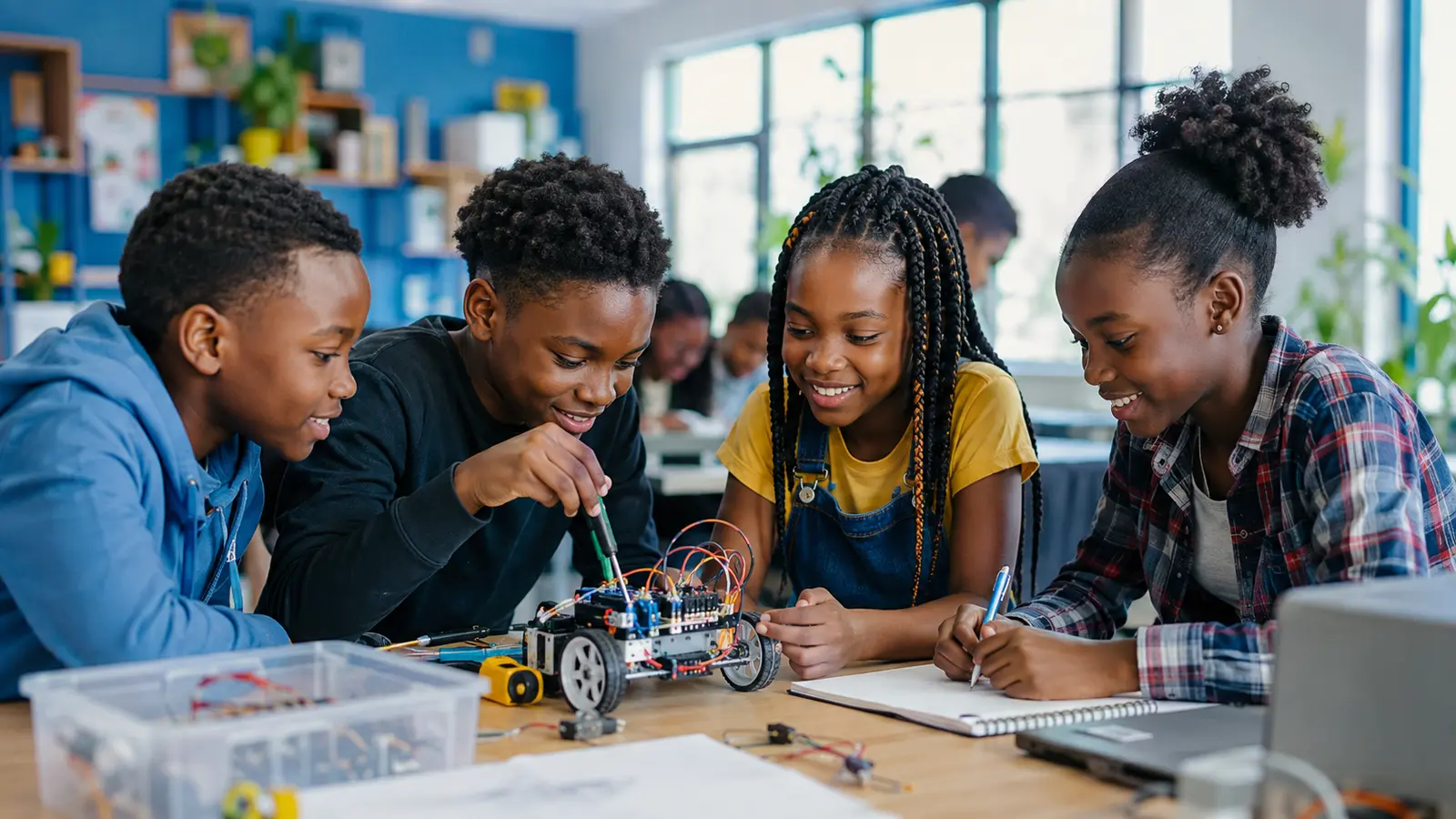
Hands-on STEM is useful because it naturally combines prediction, failure and iteration. Our STEM Education Africa guide offers a practical starting point.
6. Collaboration and emotional intelligence
Most meaningful work involves other people. Children need to listen, disagree constructively, divide responsibilities, give feedback, manage frustration and repair relationships.
Family life is a training ground. Let children contribute to shared tasks, negotiate reasonable responsibilities and reflect on conflicts. Team sports, clubs, faith communities, arts groups and project-based learning can provide additional practice.
7. Adaptability and learning how to learn
Specific tools change quickly. The ability to learn a new tool, ask for help, practise deliberately and recover from mistakes is more durable. Normalize being a beginner. Let children see adults learn new skills too.
After a project or test, ask three questions: What worked? What was difficult? What will you change next time? This turns performance into feedback rather than identity. Our guide to raising confident children in Africa explores how manageable challenges build resilience.
A future-ready weekly routine
- Read: at least one substantial piece of text and discuss it.
- Make: build, draw, cook, code, repair or create something.
- Question: verify one claim encountered online.
- Collaborate: complete one task with another person.
- Reflect: identify one mistake that produced useful learning.
What parents should avoid
Do not chase every new technology trend. Buying more devices does not guarantee future readiness. Avoid turning childhood into continuous résumé-building or treating only high-status careers as success. Children need sleep, play, relationships, health and room to discover genuine interests.
UNESCO’s broader digital education guidance highlights the importance of human agency and ethics. Technology should expand children’s capabilities without displacing the human foundations of education.
Frequently asked questions
Is coding the most important future skill?
Coding can be valuable, but it is one tool. Literacy, numeracy, critical thinking, communication, creativity and adaptability support many careers and help children learn technical skills later.
At what age should children learn about AI?
There is no single age for every child. Begin with age-appropriate ideas about how digital tools work, privacy and checking information. More advanced AI use should grow with maturity and learning needs.
How can families prepare children without expensive technology?
Use reading, household maths, discussion, puzzles, making, local projects, libraries and shared devices strategically. Many foundational future skills are built through active learning rather than expensive hardware.
Final thought
The future will reward children who can keep learning. Give them strong foundations, opportunities to solve real problems, safe experience with technology and confidence to change direction when evidence demands it. That is a more durable preparation than trying to guess which job title will matter twenty years from now.